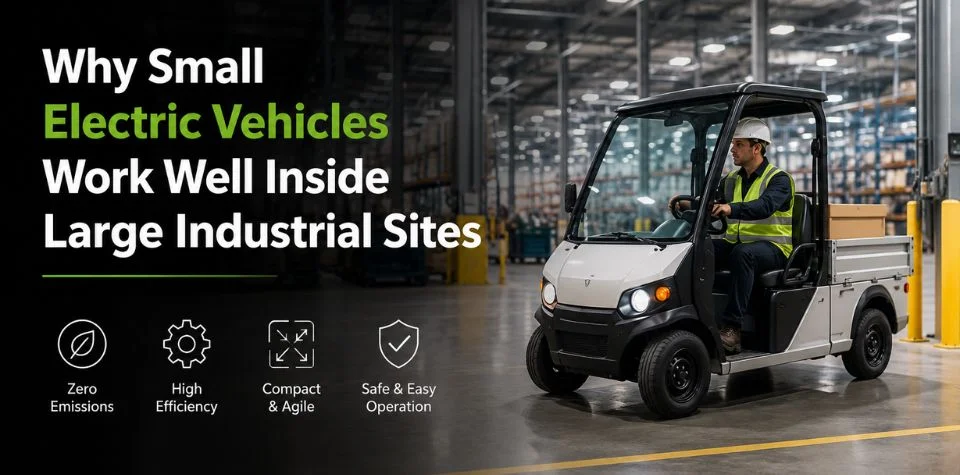
Why Small Electric Vehicles Work Well Inside Large Industrial Sites
A maintenance supervisor needs to cross a large plant with one replacement sensor.
The nearest utility vehicle may be occupied, so the trip waits or a larger machine gets diverted from heavier work.
Each delay looks small, yet the same pattern can repeat across maintenance, quality control, stores, and security throughout a shift.
Large industrial sites often contain hundreds of light journeys that sit between walking and heavy transport.
Small electric vehicles can give those journeys a vehicle sized to the task.
Find the small trips hidden inside daily operations
Small internal journeys deserve separate attention because their frequency can consume more time than their distance suggests.
A technician may travel from a workshop to a production line, while a quality team moves samples between the plant floor and a laboratory.
Stores teams may carry small components to assembly areas, and supervisors may cross several buildings during routine checks.
Mapping these trips can reveal where people wait for transport, walk long distances with tools, or borrow vehicles intended for heavier work.
Match vehicle size to the route inside the site
Compact vehicles suit many industrial layouts because turning room, access, and stopping distance often carry more value than top speed.
Large plants may include narrow service lanes, busy loading areas, indoor corridors, sharp corners, and shared spaces where pedestrians and equipment move together.
A smaller footprint helps the driver move through these areas with less disruption and park close to the destination.
Routes that cross indoor and outdoor zones should also guide decisions around tyres, suspension, ground clearance, lighting, and weather protection.
Use small EVs for frequent point-to-point work
Light, repeated tasks give small electric vehicles their clearest role inside a large facility.
Typical uses may include:
- Maintenance teams can carry tools and replacement parts between distant work areas.
- Quality teams can move samples to laboratories or inspection points during production.
- Stores teams can deliver small components, documents, and safety supplies to different departments.
- Supervisors can travel between production lines, warehouses, gates, and administrative blocks.
- Site teams can move meals, medicine, or urgent supplies during long shifts.
An electric delivery scooter supplier may offer a practical option where the site has narrow routes, light loads, frequent stops, and short trips between fixed points.
Keep heavy vehicles focused on heavy work
A mixed fleet works better when each vehicle handles the movement that suits its size and capacity.
Forklifts, loaders, trucks, and industrial transporters still carry bulk materials, pallets, machinery, and heavy loads across the site.
Small EVs can take over lighter trips that interrupt those vehicles or pull workers away from their main tasks. This separation can reduce unnecessary engine hours, simplify parking near work areas, and improve vehicle availability during busy production periods.
Fit charging into the natural rhythm of the site
Predictable site routines can make charging easier to organise because many compact vehicles return to the same base several times each day.
Shift changes, meal breaks, loading periods, maintenance windows, and overnight parking can create regular charging opportunities.
A vehicle running short internal routes may use partial charging during these pauses and complete a longer charge after the final shift.
Charging points can sit near workshops, security gates, stores, or parking bays where the vehicles already spend time.
Check safety, durability, and service access
Industrial suitability depends on how well the vehicle handles the conditions inside the site.
Visibility, braking response, speed control, lighting, load stability, tyres, suspension, and driver training all deserve attention before regular use begins.
Dust, heat, uneven surfaces, and repeated stopping can also shape the build.
An industrial vehicle manufacturer can help assess whether a compact platform has the protection, controls, load capacity, and service access required for the route.
Simple maintenance access also helps site teams manage routine checks, battery care, tyre replacement, and minor repairs with fewer delays.
Final Thoughts
Large industrial sites still need heavy equipment, but many daily journeys carry one person, one tool case, or a small part.
Giving those trips a smaller vehicle can reduce waiting, free larger equipment for heavier work, and make movement across the site easier to organise.
Our range includes compact delivery mobility, factory vehicles, industrial transporters, batteries, and charging systems, so we can look at light internal movement alongside the wider fleet.
Looking for a practical way to handle small trips across your site? Get in touch and let’s talk.
Popular Tags
- top industrial vehicle suppliers
- industrial vehicle
- electric delivery scooter
- deliver scooter manufacturer
- delivery scooter suppliers
- ev scooter manufacturer
- ev scooter suppliers
- industrial vehicle manufacturers
- scooter manufacturers
- advanced industrial vehicle
- industrial vehicle manufacturer
- advanced industrial vehicle manufacturer
- industrial vehicle suppliers